
Understanding PCOS Beyond Hormones
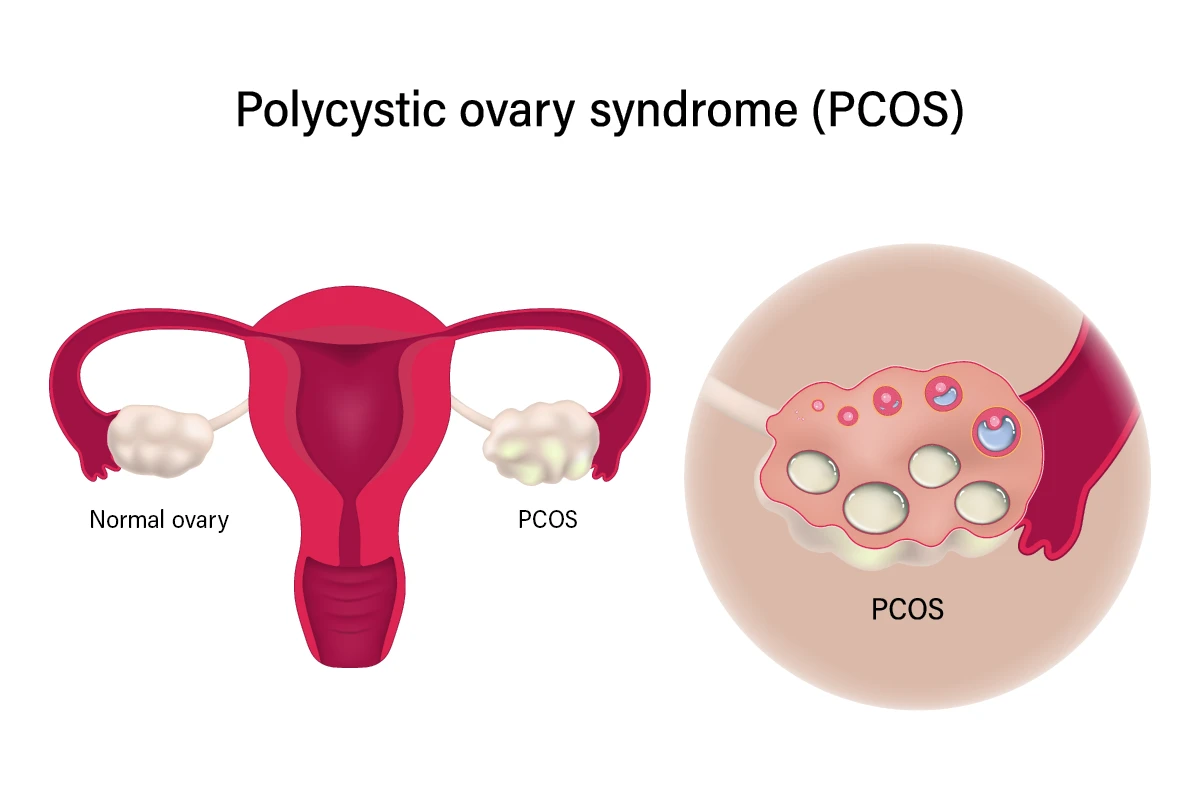
Polycystic Ovary Syndrome (PCOS) is one of the most prevalent gynecological conditions
affecting women today. In India, its prevalence varies between 3.7% and 22.5%, with an average
rate of around 11.3%. Clinically, PCOS presents with irregular or delayed menstruation, weight
gain, acne, excessive hair growth, hair thinning, lethargy, constipation, and infertility. Although
modern medicine explains PCOS primarily as a hormonal imbalance involving insulin, LH, and
androgens, Ayurveda considers it a deeper systemic disorder involving digestion, metabolism, and
reproductive tissue nourishment.
Ayurveda does not describe PCOS as a single disease entity but understands it through
various gynecological disorders classified under Yoni Vyapad. A fundamental Ayurvedic principle
states that disorders of the female reproductive system cannot occur without disturbance of Vata
Dosha, the force governing all movements in the body, including menstruation and ovulation.
When Vata is disturbed or obstructed, the natural rhythm of the menstrual cycle is disrupted.
From an Ayurvedic viewpoint, PCOS commonly involves Kapha dominance, leading to
stagnation, heaviness, and cyst formation, along with impaired Vata function. At a tissue level,
Ayurveda emphasizes the importance of Rasa Dhatu, the first of the seven body tissues formed
after digestion. Properly formed Rasa Dhatu nourishes the entire body, and its secondary tissue,
Artava (menstrual flow), reflects reproductive health. When digestion is weak, Rasa Dhatu
becomes deficient or impure, resulting in disturbed Artava and menstrual irregularities.
Another important concept in PCOS is Avarana, a functional obstruction in the bodily
channels. Even when tissue formation is adequate, obstruction to the movement of Artava caused
by disturbed doshas can lead to delayed or absent menstruation. This obstruction is subtle and
physiological, not structural.
Ayurveda therefore views PCOS as a condition resulting from improper digestion, lifestyle
imbalance, dosha disturbance, and impaired tissue nourishment. Understanding these foundational
concepts is essential before approaching treatment.
In the next part, we will examine the specific causative factors and detailed Ayurvedic
pathology of PCOS
Ayurvedic Pathology of PCOS: Causes and Mechanisms
From an Ayurvedic clinical perspective, PCOS does not arise from a single pathological
process. It is most commonly observed through three distinct mechanisms, each with different
causative factors and therapeutic implications. Accurate identification of the underlying pathology
is essential for successful management.
In nearly 70% of PCOS cases, the primary pathology is Rasa Dhatu Dushti or Kshaya. The
causative factors include irregular dietary habits, consumption of heavy, processed, or nutritionally
deficient foods, disturbed sleep patterns, chronic stress, excessive mental exertion, and lack of
routine. These factors weaken Agni, resulting in improper digestion and poor formation of Rasa
Dhatu. Since Artava is an Upadhatu of Rasa, inadequate or impure Rasa leads to disturbed Artava
production. Clinically, this manifests as delayed menstruation, scanty flow, irregular cycles, or
anovulation.
Approximately 20% of PCOS cases are attributed to Avarana, or functional obstruction of
Vata Dosha. In these patients, the formation of Rasa and Artava is relatively adequate, but their
normal movement is impaired. Causative factors include excessive physical exertion, travelling
during menstruation, late-night awakening, day sleeping, suppression of natural urges, alcohol
intake, and psychological stress. These factors lead to obstruction of Vata by Kapha (stagnation),
Pitta (excess metabolic heat), or Ama (toxins). As Vata governs the expulsion of Artava, its
obstruction results in irregular or absent menstruation despite proper tissue formation.
In a smaller but clinically significant group—approximately 10% of cases—PCOS arises
neither from Rasa Dhatu deficiency nor from Avarana, but from primary disorders of the Yoni and
Artavavaha Srotas. In such cases, the defect lies in the production, maturation, or regulation of
Artava itself, often due to congenital abnormalities, Bija Dushti (genetic factors), or intrinsic
dysfunction of the reproductive organs. These conditions correspond more closely to classical Yoni
Vyapad described in Ayurvedic texts and require a distinctly tailored therapeutic approach.
Ayurveda emphasizes that although the clinical presentation of PCOS may appear similar,
the underlying pathology differs significantly among individuals. Factors such as Prakriti, age,
chronicity, mental state, region, and seasonal influence determine disease expression and response
to treatment.
Therefore, PCOS cannot be effectively treated with a uniform protocol. A precise
understanding of the dominant pathology is fundamental for successful and sustainable
management

Ayurvedic Management of PCOS: Role of Panchakarma
Ayurvedic treatment of PCOS is focused on correcting the underlying pathology rather than
providing temporary symptomatic relief. The cornerstone of management lies in Panchakarma, the
classical detoxification and bio-purification therapies designed to eliminate aggravated doshas and
restore physiological balance.
In PCOS cases dominated by Kapha accumulation and metabolic sluggishness, Vamana
Karma (therapeutic emesis) plays a significant role. Vamana helps eliminate excess Kapha and
Ama from the body, improves metabolic activity, enhances insulin sensitivity, and clears the
obstructed channels. This therapy is particularly beneficial in patients with obesity, lethargy,
excessive mucus formation, and cystic tendencies.
Virechana Karma (therapeutic purgation) is especially effective in PCOS cases involving
Pitta imbalance and hormonal dysregulation. Virechana purifies the liver and hormonal pathways,
regulates metabolism, reduces inflammation, and improves endocrine function. By cleansing the
system at a deeper level, it supports regular ovulation and menstrual rhythm.
While Basti therapy (medicated enema) remains important in correcting Vata disorders and
Avarana, Vamana and Virechana are often essential as primary purification procedures to prepare
the body for effective long-term healing. These therapies are administered only after proper clinical
evaluation and preparatory procedures, ensuring safety and efficacy.
While the Panchakarma procedures may appear similar, the medicines used, duration of
treatment, and intensity of therapy are carefully customized for each patient. This is essential
because every individual has a unique body constitution and stage of disease, ensuring safe
detoxification, better tolerance, and long-lasting healing.
Following Panchakarma, carefully selected Ayurvedic formulations, dietary regulation,
daily routine correction, yoga, and stress management are prescribed to rebuild tissue health and
maintain hormonal balance. This integrative approach helps prevent recurrence and supports
fertility naturally.
At Parachin Holistic Care, Ahmedabad, PCOS management is conducted through
individualized Panchakarma protocols under expert medical supervision. Our focus is on restoring
the body’s innate balance and supporting women through a safe, sustainable, and holistic healing
process.
PCOS is not merely a hormonal disorder—it is a reversible imbalance when addressed at
its root
Authored by Dr. Daxal Kavad MD, BAMS (Ayurveda)